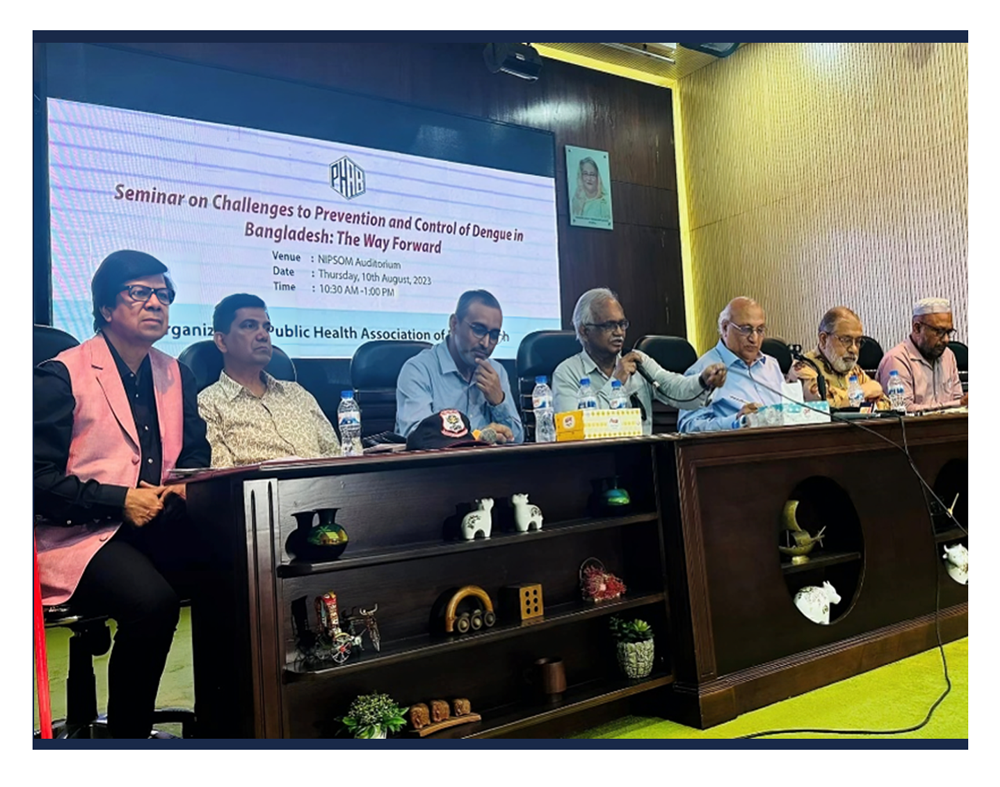
Public Health Association of Bangladesh (PHAB) has organized a high level seminar on "Challenges to Prevention and Control of Dengue Fever in Bangladesh: The Way Forward" on 10th August, 2023 at NIPSOM Auditorium from 10.30AM-1:00PM for strengthening National Coordinated Dengue Responses. The key notes were presented by Senior Public Health experts, Entomologist, followed by an experts' panel discussions with key Government/DGHS officials, Public Health professionals, Academicians, Media professional and Representative from Dhaka North City Corporation. It was very successful seminar with approx. 300 participants including Government officials, NGOs/CSOs, private sectors, media and NIPSOM faculty members, post graduate students and representatives from City Corporations. The session was moderated by PHAB officials and press release published in major national print, electronic and television media.
PHAB has highlighted the overarching principles of Whole of Government and Whole of Society approaches in the fighting of Dengue outbreak for effective prevention, and control of Vectors/mosquito spread and treatment in Bangladesh. This would include partnerships between different key Government ministries & departments, multi sectoral collaborations, NGOs/CSOs, private sectors, local government and communities including religious institutions like mosques, education institutes, community social clubs and other worship places for a unified approach of fighting the Dengue.
Date: Thursday, 10th August, 2023
Venue: NIPSOM Auditorium
Time: 10.30AM-1:00PM
Challenges to Prevention & Control of Dengue in Bangladesh: The Way Forward
Call for Action:
Guiding Principle:
PHAB proposes the principle of Whole of Government and Whole of Society approach in fighting the Dengue outbreak for effective implementation of prevention, and control of mosquito spread and treatment of Dengue cases. This would include partnerships between different government Ministries, NGOs/CSOs, private sector entities, local communities including religious institutions like mosques and other worship places for a unified approach of fighting Dengue.
The Way Forward with Action Points:
1. Enhanced Public Awareness towards behavior change through Risk Communication and Community Engagement:
- Continue risk communication and comprehensive public awareness campaigns through media (Television and Community Radio), aggressive social media post, and community gatherings. This activity be initiated by LD, Life Style and Healthy Life, DGHS, and monitored by Ministry of Information and Ministry of Social Welfare.
- Adolescent boys and girls to educate citizens about dengue transmission, and prevention, and early symptom recognition through schools, colleges and Universities. In this regard Boys Scouts, Girl Guides, Rover Scouts, and members of BNCC be engaged through the Ministry of Education.
- Foster community involvement in eliminating breeding sites by organizing regular clean up drives, waste management, and encouraging community/residents to maintain mosquito-free environments. Ministry of Local Government should take up steps in this regard. Ministry of Home Affairs (particularly making available Ansars and VDPs) and Ministry of Local Administration should join hands with MOLGRDC.
- CSOs/NGOs, Development partners, private sector entities should come forward and work with the local government institutions and other Government agencies to plan greater roles like coordination with Union Parishad, Upazilla Health Complex, Dist. coordination, and City Corporation committees. The RCCE (Risk Communication and Community Engagement) platform under the joint leadership of UNICEF and LD, CDC, DGHS be reinvigorated and activities may be initiated.
- As a part of prevention measures use of insecticide treated bed nets be promoted. Ministry of Social Welfare can take up steps accordingly.
2. Strengthening Healthcare Capacity and Initiate Creative and innovative case management system:
- Strengthen healthcare facilities' readiness and capacity to manage Dengue cases by providing training for health service providers, medical personnel, ensuring adequate medical supplies, and creating surge capacity at the periphery Hospitals and Medical Colleges. DGHS should circulate the Dengue Case Management protocol and conduct online training sessions where NGOs can provide support particularly in the urban areas.
- Triaging patients, increase Dengue tests at the periphery level and utilize the GPs to take care of dengue patients through close supervision and follow-up. DGHS should collaborate with BPMPA to set up a system enabling the GPs to take up the necessary responsibility.
3. Integrated Vector Control:
Implement comprehensive and sustainable mosquito control programs, integrated control room for analyzing data, insecticide-treated bed nets, and safe insect repellents. Insecticide resistance surveillance.
4. Constant Monitoring and Evaluation with Effective Surveillance System:
- Regularly assess the effectiveness of prevention and treatment strategies, adapting them based on data-driven insights to ensure continuous improvement in Dengue control efforts by DGHS and other partners. In this connection LD, CDC, DGHS and LD, HMIS, DGHS should start working together with immediate effect.
- Involve the Prime Minister's office in planning, coordination and sustained implementation of all activities controlling the Dengue outbreak. DG, DGHS shall have to move a file through the relevant Secretary, MOHFW to get the PM's office on board.
- Establish a robust community and hospital based Dengue surveillance system to monitor and track cases, enabling timely responses and allocation of resources to high-risk areas. Within this system a Dengue death case review be initiated. IEDCR, DGHS and icddr,b be entrusted to undertake this activity.
PHAB has highlighted the overarching principles of Whole of Government and Whole of Society approaches in the fighting of Dengue outbreak for effective prevention, and control of Vectors/mosquito spread and treatment in Bangladesh. This would include partnerships between different key Government ministries & departments, multi sectoral collaborations, NGOs/CSOs, private sectors, local government and communities including religious institutions like mosques, education institutes, community social clubs and other worship places for a unified approach of fighting the Dengue.
Date: Thursday, 10th August, 2023
Venue: NIPSOM Auditorium
Time: 10.30AM-1:00PM
Challenges to Prevention & Control of Dengue in Bangladesh: The Way Forward
Call for Action:
Guiding Principle:
PHAB proposes the principle of Whole of Government and Whole of Society approach in fighting the Dengue outbreak for effective implementation of prevention, and control of mosquito spread and treatment of Dengue cases. This would include partnerships between different government Ministries, NGOs/CSOs, private sector entities, local communities including religious institutions like mosques and other worship places for a unified approach of fighting Dengue.
The Way Forward with Action Points:
1. Enhanced Public Awareness towards behavior change through Risk Communication and Community Engagement:
- Continue risk communication and comprehensive public awareness campaigns through media (Television and Community Radio), aggressive social media post, and community gatherings. This activity be initiated by LD, Life Style and Healthy Life, DGHS, and monitored by Ministry of Information and Ministry of Social Welfare.
- Adolescent boys and girls to educate citizens about dengue transmission, and prevention, and early symptom recognition through schools, colleges and Universities. In this regard Boys Scouts, Girl Guides, Rover Scouts, and members of BNCC be engaged through the Ministry of Education.
- Foster community involvement in eliminating breeding sites by organizing regular clean up drives, waste management, and encouraging community/residents to maintain mosquito-free environments. Ministry of Local Government should take up steps in this regard. Ministry of Home Affairs (particularly making available Ansars and VDPs) and Ministry of Local Administration should join hands with MOLGRDC.
- CSOs/NGOs, Development partners, private sector entities should come forward and work with the local government institutions and other Government agencies to plan greater roles like coordination with Union Parishad, Upazilla Health Complex, Dist. coordination, and City Corporation committees. The RCCE (Risk Communication and Community Engagement) platform under the joint leadership of UNICEF and LD, CDC, DGHS be reinvigorated and activities may be initiated.
- As a part of prevention measures use of insecticide treated bed nets be promoted. Ministry of Social Welfare can take up steps accordingly.
2. Strengthening Healthcare Capacity and Initiate Creative and innovative case management system:
- Strengthen healthcare facilities' readiness and capacity to manage Dengue cases by providing training for health service providers, medical personnel, ensuring adequate medical supplies, and creating surge capacity at the periphery Hospitals and Medical Colleges. DGHS should circulate the Dengue Case Management protocol and conduct online training sessions where NGOs can provide support particularly in the urban areas.
- Triaging patients, increase Dengue tests at the periphery level and utilize the GPs to take care of dengue patients through close supervision and follow-up. DGHS should collaborate with BPMPA to set up a system enabling the GPs to take up the necessary responsibility.
3. Integrated Vector Control:
Implement comprehensive and sustainable mosquito control programs, integrated control room for analyzing data, insecticide-treated bed nets, and safe insect repellents. Insecticide resistance surveillance.
4. Constant Monitoring and Evaluation with Effective Surveillance System:
- Regularly assess the effectiveness of prevention and treatment strategies, adapting them based on data-driven insights to ensure continuous improvement in Dengue control efforts by DGHS and other partners. In this connection LD, CDC, DGHS and LD, HMIS, DGHS should start working together with immediate effect.
- Involve the Prime Minister's office in planning, coordination and sustained implementation of all activities controlling the Dengue outbreak. DG, DGHS shall have to move a file through the relevant Secretary, MOHFW to get the PM's office on board.
- Establish a robust community and hospital based Dengue surveillance system to monitor and track cases, enabling timely responses and allocation of resources to high-risk areas. Within this system a Dengue death case review be initiated. IEDCR, DGHS and icddr,b be entrusted to undertake this activity.